
Both of them have grown up in a different world. One was the darling princess of her world , which consisted the family, friends and the ever-present family friends. Other was a victim , of violence, vices and of that thing called " human love ". Yet one thing , one thing which bought them together was that huge laburnum tree and blooming orchids on its branches. The yellow buds of the Indian laburnum enticed both of them , like they've been seducing the tiny little Himalayan bees for the generations.
Yana was born in a family of four brothers and two mothers. Their father , basically —a self-made man, or so people said— , was someone who loved his daughter more than others . For him , his daughter was the only girl in the world worth all love . So much so, that he’d stopped himself from bringing home his third mistress just so he wouldn’t hurt Yana’s tiny heart.
Not because he had reformed. Not because fatherhood had made a man of him.
But because Yana's mother, soft and submissive, would drown her grief in the turquoise depths of the lonely Sinyik river and her “elder mother” had long run out of love to spare—exhausted by age, by sorrow, and the act of loving an adulterous husband and his name-bearers. .
Yaw’s world was a different script altogether.
Unlike Yana, she had seen it all.
She had lived it.
So closely—that she had watched her uncle rape her grief-stricken, widowed mother the very week her father died in that terrible accident. So closely—that she could tell, from the pain of the penetration, whether it was her uncle or one of the clients he’d pimped her to that was "making love" to her in the dark.
So closely—that she could guess, by the taste of their mouths, how much they’d paid him.
So closely—that she could tell, by the cruelty of each man’s rhythm, whether she’d be enduring such torment the next night—or the night after that.
This was her.
As life had ordained it to be.
Yet here they were—Yana and Yaw.
One basking in the filtered warmth of social adoration, the other shaped in the mold of violation and silence.
But together—beneath that laburnum tree—they found a rhythm. Not quite happiness, no. But something tender. Something real.
Something raw like the smell of wet soil after the first summer storm.
The tree never judged. Its roots cradled their secrets. Its wide arms gave shelter. The yellow laburnum flowers swayed above them like golden sins too beautiful to be punished.
Yana used to bring books—Yeats, Mahadevi Verma, and sometimes that obscure Naga poet who wrote of women like they were fire wrapped in lotus petals. Yaw listened, sometimes tracing letters on Yana’s palm as she read aloud, her voice half-music, half-hunger.
Yaw had never learned to read. But she knew what love sounded like. And Yana had never learned what hunger looked like, until she looked into Yaw’s eyes.
Or maybe they both knew. Maybe they both pretended not to.
Who knows?
Maybe.
Or may not be.
It went on like this.Seasons turned. The flowers bloomed and wilted, and bloomed again. Yana started smelling like fig sap and river clay. Yaw, for the first time, started to sleep without flinching.
But fairy tales are carved from bones. The world, of course, noticed. First it was the neighbours. The woman with the green blouse who always smiled too tightly. She must have felt something . Something odd about the bond between these two teenager girls . Yet she'd never tell what . Maybe the town , the colony where they lived was still decades behind to understand this .Not ready. Not willing. Who knows ? Maybe . Or may not be.
Then came Yana’s aunt, who found a pressed orchid in one of her books. She thought , one of the boys must have given her . Just like how she used to get flowers herself when she was of her age . And she chuckled . “Flowers today are just gifts in advance, to make up for tomorrow’s floggings.”
Who knows ? Maybe . Or may not be .
Then her father. Maybe he too realised that it's the time . Or maybe his own guilt, his sins started haunting him . Maybe the cries of the foetus he'd got aborted were laughing at him . Maybe the souls of that young mistress who jumped off from Mel Botom , with her swollen belly was smiling at him . Now that he's a father of a young girl , his own actions were before his eyes .
Maybe it was just business. One more way to stake his claim in the power games of men: To sell off his daughter to the highest bidder— as had been custom all along. He told himself—maybe—his sons would carry his name, but it was she—his daughter—who could build it.
Who knows? Maybe. Or maybe not.
His voice was soft—too soft—when he called her kv, beti and asked, “Have you forgotten who you are?” And with all his adoration and love , with all the tenderness he could fake, he stroked her head gently.
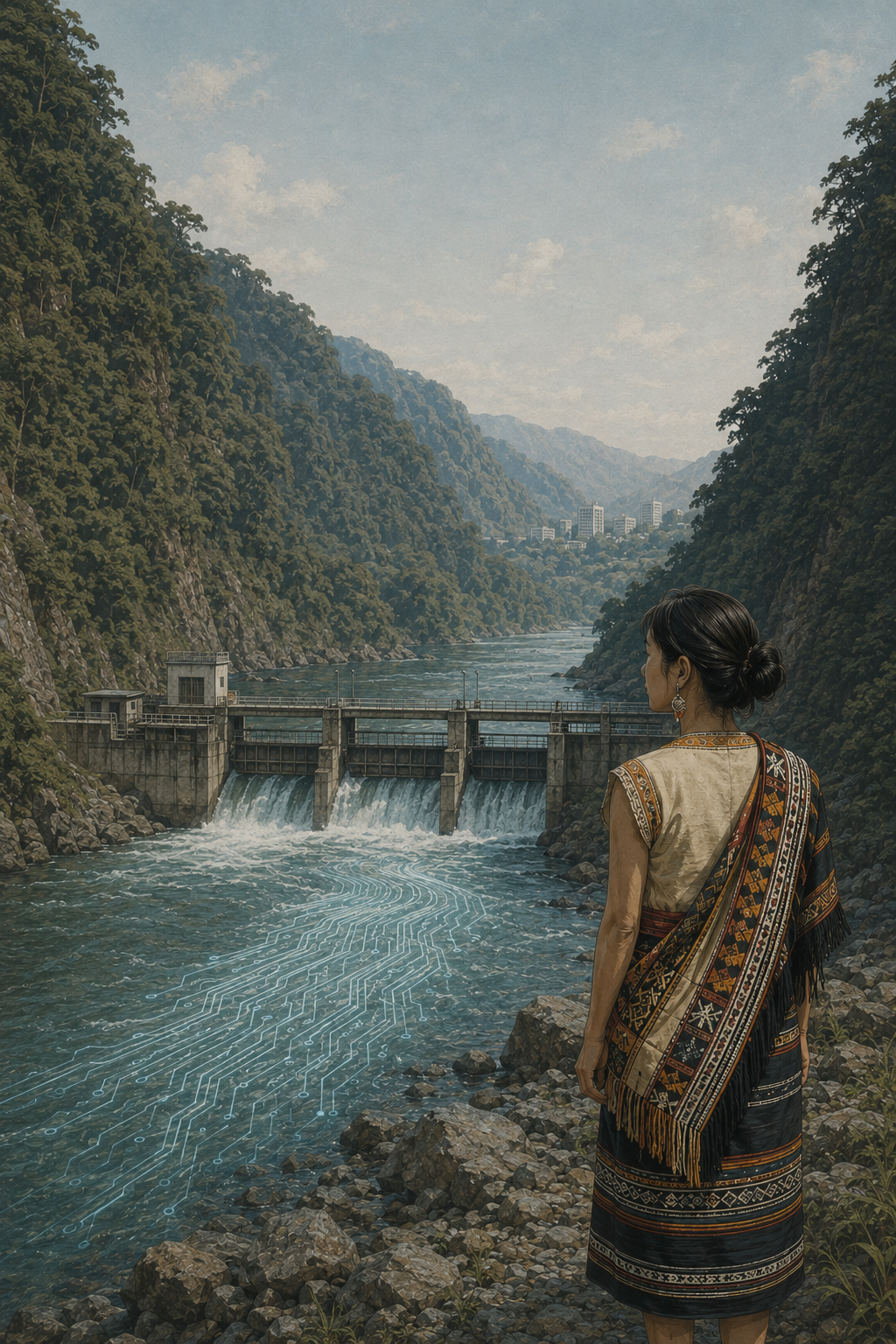
Then came the suitor. An engineer, they said . In some department with three fancy letters in it. The kind that builds things where nothing stands. Or perhaps, someone whispered, “the kind that builds things that can never be.” A smile like a brass plate, polished and empty. He wore neatly ironed shirts, spoke of rivers, roads and development, and looked through Yana like she was a scheduled project. Her price was fixed : 50 sebes ( mithuns ) , 20 cows and as much as eriks ( swines ) as possible.
The wedding would happen after Yana cleared her Higher Secondary. After all, just like porcelain tiles in a drawing room, an educated woman adds elegance to a household.
The project was awarded to the highest bidder. No inspection. No concern whether the man was capable—or a curse. After all, who ever cared about girls and roads? If they cracked, you just replaced them.
That night, Yana ran to the laburnum tree.
Yaw was already there, barefoot, holding an orange wrapped in an old newspaper. But still, she hoped. Maybe Yana would rethink. Maybe the fragrance of orchids would overpower the scent of imported perfumes. Maybe the memory of their kisses would be stronger than the promise of gold bangles . Who knows ? Maybe . Or may not be .
“Do you want to go away?” Yaw asked.
“With me?”
Yana didn’t answer.
She cried instead. Her shoulders shook. The orchids trembled too.
“They’ll never let me live,” Yana said.
“They’ll never let me die either.”
Yaw looked at her for a long time. Her lips parted like she was about to speak, but instead she leaned forward and kissed her—deep, desperate, final.
Then, in a voice as low as thunder rolling over riverbed stones, Yaw said,
“Then let’s stop time.”
They made love like a prayer. Not to God, but to that tree.
Yaw whispered stories into Yana's skin—stories without words, full of bruises, and warmth, and moonlight. She kissed the places others would never touch—not even in dreams.
And when Yana finally fell asleep, fingers curled into a fist over her heart, her body slack with trust—
Yaw sat up.
She reached for the garland she had braided that morning. A golden noose woven from centuries of desire. She held it in her palms for a long time, turning it over like a question with no answer.
The orchids swayed above them. The tree stood witness.Yaw's hands trembled. Or maybe they didn't. In the dark, it's hard to tell what's real and what's merely the memory of wanting to be real.
She leaned down and kissed Yana's forehead once more.
When they found them the next morning—
Yana lay beneath the laburnum tree, hair spread like roots, body folded like a prayer. The garland was wound loosely around her neck, or perhaps only tangled there by accident.
Her eyes were closed. Her lips held the shadow of something—a smile, a scream, a secret.
No one could tell if she had simply slept and never woken.
No one could tell if she'd chosen to stay.
No one could tell anything at all.
And when the morning came, with all its noise and men and names and knives, they found her too—
Yaw, seated beside Yana’s body, eyes open, unblinking, smiling.
The neighbors whispered. Yana's father wept—or pretended to. The engineer found another bride.
And the laburnum tree? It stood as it always had.
Every season, it bloomed.
Every season, the flowers were still golden, still beautiful, still impossibly tender.
Maybe they'd loved each other.
Maybe they'd saved each other.
Maybe they'd destroyed each other.
Maybe one of them had chosen to leave.
Maybe neither of them ever really could.
Who knows?
Maybe.
Or may not be .

Write a comment ...