

The crow lay motionless beneath the spreading canopy of the Bel tree, one wing twisted awkwardly beneath his body, as though he had fallen in the middle of a sentence.
Around him, the morning park of Itanagar continued its familiar rhythm. Children chased a punctured football across the dusty ground. Old men argued over politics with the confidence of lifelong philosophers. Joggers counted their steps as though they were counting down life itself.
But beneath the tree, there was grief.
His mate hopped frantically around the lifeless body, striking her breast with her beak and crying in a cracked voice that sounded almost human in its despair.
"Wake up," she cawed. "The sun has risen. You always wake before the sun."
Again and again she nudged him.
The dead crow did not move.
On the branches above, his relatives perched in silent rows like black leaves against the sky. Their cries had grown softer now, exhausted by mourning.
One old crow shook his head.
"What shall we do with him? There isn't even a place for the poor after death."
Another replied, "The city promised us an electric crematorium. The contractor swallowed the funds. Only the foundation stone remains."
A third crow let out a hollow laugh. "Foundation stones never die. Only creatures do."
High above them, on the tallest branch of a neem tree, the Eagle King watched with cold yellow eyes—majestic, solitary, untouched by sorrow. The crows waited for a decree, a gesture of sympathy, some acknowledgment from the ruler of the skies. Instead, the eagle merely stretched his wings and muttered,
"What would make a finer breakfast today—a squirrel or a green pigeon?"
The death below did not disturb his appetite.
Nearby, a squirrel sat comfortably on another branch of the Bel tree, cracking open a ripe fruit with tiny, delighted teeth. Bits of pulp fell beside the dead crow's feet.
The squirrel neither looked down nor looked back.
Hunger, after all, has little patience for mourning.
The afternoon deepened. The widow's cries became hoarse. One by one, the relatives flew away in search of food, water, and survival. Even grief cannot compete forever with an empty stomach.
At dusk, a municipal truck rattled into the lane beside the park. A sweeper, covering his nose with a dirty cloth, lifted the crow's body with two sticks and tossed it carelessly into a green dustbin already overflowing with plastic cups, rotting fruit peels, broken bottles, and forgotten things.
No pyre. No prayer. No sky burial beneath the open wind to which he had belonged all his life.
Only garbage.
I watched everything from a cracked iron bench in the little town park while traffic hummed beyond the walls like a restless machine. Around me fluttered pigeons, mynas, parrots, kites, and squirrels—a whole republic of creatures somehow surviving amidst concrete, noise, and smoke. And suddenly, I remembered the forests of my hometown in the hills.
The endless green valleys of my childhood, where dawn once arrived with a thousand birdcalls layered upon one another like sacred chants. In those forests, crows gathered noisily around bamboo groves and village hearths. Their voices were so ordinary that no one imagined a day when silence would replace them. Now, whenever I return home, I search the trees and hear almost nothing.
The forests are still standing.
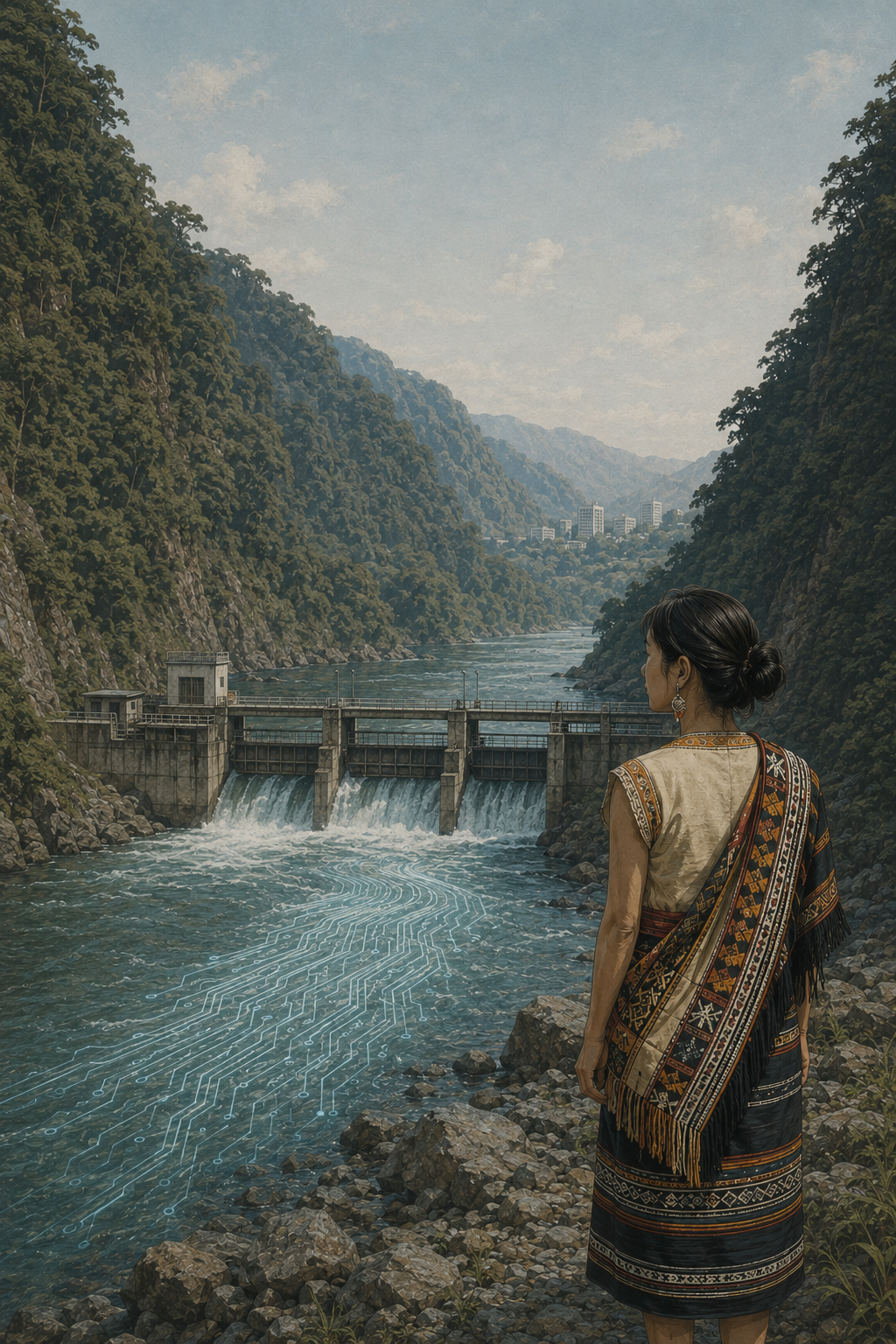
The rivers still flow.
The mountains still hold their ancient silence.
But the birds are slowly disappearing.
And perhaps that is the saddest death of all. For a forest does not die when its trees are cut down. It begins to die when its songs fall silent.


Write a comment ...