

Arunachal Pradesh, 1960. The foothills held their secrets close—and their mercies closer still.
Tadak stood outside his bamboo house at dawn, watching mist settle over the valley. Inside, his youngest child burned with fever that no root, no herb, no prayer had broken. Four times before, he'd stood in this same doorway. Four times he'd buried a child.
His wife, Meso, hadn't left the boy's side in three days. She was a strong woman—the Nyishi didn't raise weak ones—but strength has limits. When your body has carried five children and returned four of them to the earth, something in you begins to fracture.
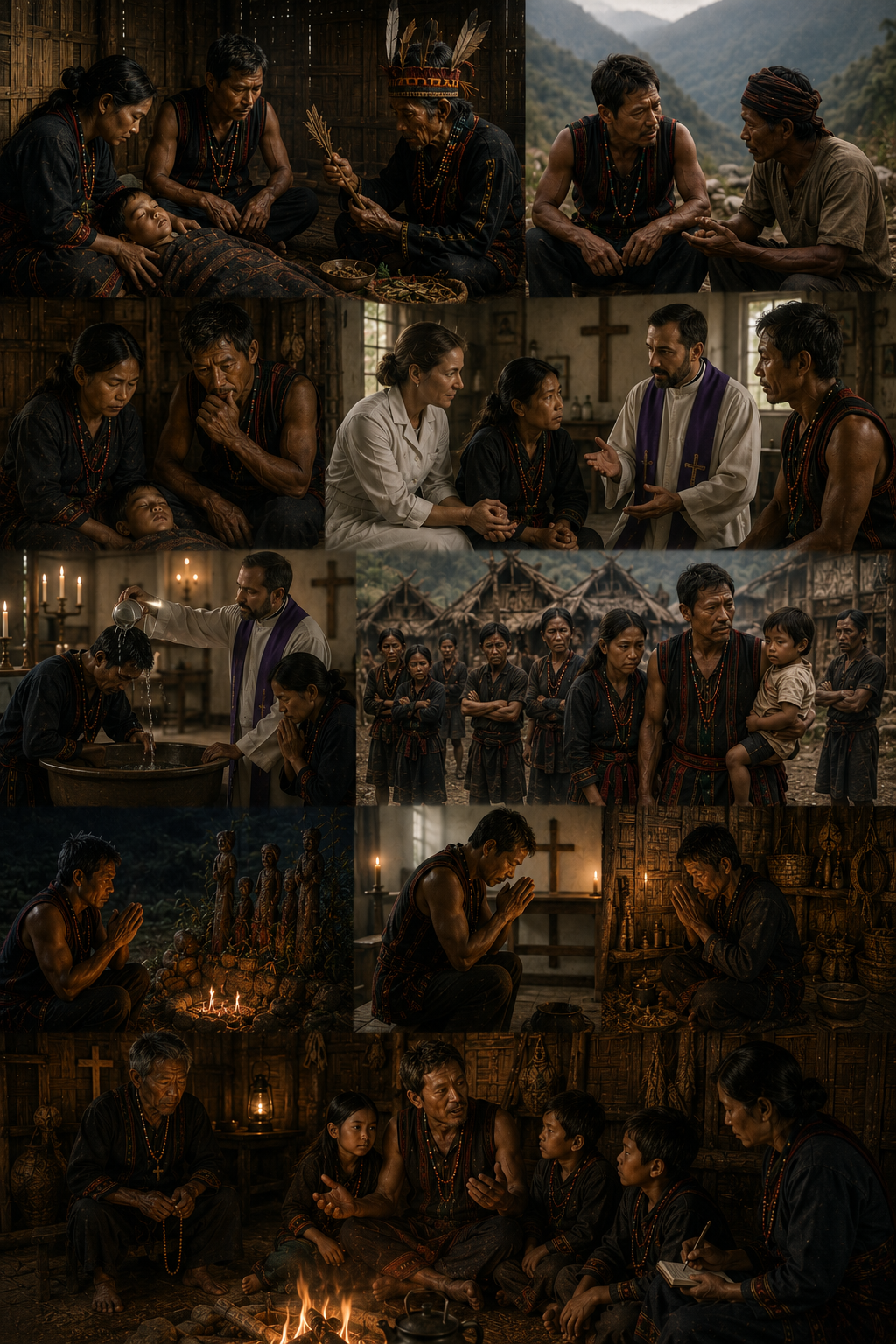
The nyibu had come two weeks ago. The nyibu was old, respected, a man who'd cured fevers and bone breaks and the sickness that comes from a broken spirit. Tadak had paid him everything—rice he could barely spare, cloth his family needed, his good knife. The ceremonies had cost more: chickens for the rituals, offerings to the spirits, payment for the shaman's knowledge.
The child had only gotten worse.
Tadak worked as a porter for the policeman in Pasighat, carrying loads through terrain that would break ordinary men. It was work that kept them barely alive. He made enough to eat. No more. The visits to the nyibu had bled him dry. Now his son was dying, and he had nothing left to offer the spirits.
On the fourth day, when his son's breathing had become shallow and irregular, Tadak sat with Soron during their midday rest.
Soron was Adivasi, from the tea gardens in Assam. His people—the Tea tribes—had been brought there as laborers, worked almost to death. Years ago, when Soron was dying of the same fever that now claimed Tadak's son, the Catholics had come to the tea gardens.
"They didn't ask for money," Soron had told Tadak once, months before. "They came to us with medicine. A woman doctor named Sister Catherine. She treated people for free—people like us, people no one else would touch."
Tadak had listened then, but not truly heard. His own gods were still answering prayers. His own ways still held power. He'd been proud then, still confident in the old order.
Now pride was a luxury he couldn't afford.
"There's a mission clinic in Pasighat," Soron said quietly, seeing Tadak's desperation. "The same people who helped me. They have medicine—real medicine. The doctor is named Sister Catherine. Father Alvares runs the clinic."
"What did they ask you to do?" Tadak said. He understood transactions. Everything had a price.
Soron was quiet for a moment.
"They asked me to convert. To leave my sinful way of life, confess my sins, accept Jesus Christ as my savior. They said the medicines only work if the spirit is also healed. If I remained in darkness, the medicines would fail."
"And you agreed?"
"I was dying," Soron said simply. "My family had abandoned me. The village elders said the fever was punishment for my failings. The shamans wanted payment I didn't have. But the missionaries—they came without asking for anything first. Sister Catherine looked at me and simply began treating me. No payment. No negotiation. Just kindness."
He paused.
"When she was treating me, Father Alvares spoke about Christ. About forgiveness. About being reborn. At first, I thought it was part of the medicine—just words I had to accept to get the treatment. But then I realized... he meant it. He genuinely believed that Christ could save me in a way the spirits couldn't. That my ancestors had failed me, but Jesus wouldn't."
"Did you believe him?" Tadak asked.
"I believed that I was alive," Soron said. "And I was alive because of them. Because of their kindness. So I chose to believe in their God too."
That night, Tadak sat with Meso in the darkness. Their child lay between them, barely breathing now. The boy's name was Tanga . He was their last hope, their final chance at a future.
"We should try the mission," Meso said, her voice hollow with the weight of four dead children.
"They'll ask us to convert."
"Yes."
"We'd have to deny everything. The spirits. The ancestors. The nyibu."
"Yes," Meso said again. "But Tanga is dying, Tadak. And we have nothing left to give the spirits. We've given everything. Our money. Our faith. Our other children. And they've taken them anyway."
Tadak understood what she was saying. The old gods weren't answering. The nyibus had only taken his money while his children died. The traditions that had sustained his people for generations had failed him when he needed them most.
"The missionaries ask us to choose a different god," Meso continued. "But at least they offer something in return. At least they have the medicine."
It wasn't faith. It was desperation wearing faith's clothes.
They left before dawn, carrying Tanga wrapped in cloth. Tadak walked ahead, Meso behind, both silent. Three days' journey to Pasighat. Three days to reach the mission clinic and the choice they'd already made.
Sister Catherine was waiting—or so it seemed. She'd seen dozens of cases like this. A child fevered almost to death. Parents desperate. The unspoken negotiation hanging in the air like smoke.
She didn't make them wait for diagnosis or sermon. She simply looked at the boy and said, "Malaria. I can treat this."
"What does it cost?" Tadak asked. He'd learned that everything had a price. The question was what they'd have to surrender.
"The medicine itself is free," Sister Catherine said. "But Father Alvares will want to speak with you about your souls."
Father Alvares came in the evening. His Hindi was imperfect, with a tint of Malayalam or whatever South Indian he spoke but his meaning was precise. He didn't preach at them. He simply spoke truth as he understood it.
"Your child is very ill," he said. "The fever is a sickness of the body. But there's also a sickness of the spirit—one that prevents healing even when medicine is given. The spirits you worship, they cannot save you. They have already proven this by taking your other children."
Tadak flinched. It was cruel, perhaps, but not untrue.
"Jesus Christ can save your child," Father Alvares continued. "But you must turn away from your sinful practices. You must confess your reliance on false gods, ask forgiveness, and accept Christ as your savior. This is the condition. Not because I demand it, but because it is the truth. The medicine will heal the body only if the spirit is also healed."
"What if we refuse?" Meso asked.
Sister Catherine knelt beside Meso, her eyes level with hers. She took Meso's hand gently.
"I have treated many people," Sister Catherine said softly. "Some who believed, and some who didn't. The medicine helps them all. The quinine will work in your son's blood whether he prays to Christ or to the spirits of the forest. I would not lie to you about that."
She paused, her voice steady but filled with genuine care.
"But I have also seen something else. I have seen people who were healed only in their bodies, whose spirits remained broken. They survived the fever, but they did not truly live afterward. They carried the darkness with them. And I have seen people who accepted Christ—truly accepted him, not just with words—and they were healed in their whole selves. Body and spirit together."
She gestured to the bottle of quinine.
"This medicine is a gift. I give it freely to anyone who comes to us. But I would not be honest with you if I didn't tell you what I believe to be true: that healing comes not just from the medicine in this bottle, but from the healing of the heart. When a person stops running from God, stops clinging to the darkness—that is when true healing begins."
Sister Catherine's eyes were kind, but serious.
"Your son needs this medicine. But more than that, he needs your faith. Not faith in the quinine—faith in something greater than yourselves. Faith that you are not abandoned. Faith that there is mercy. That there is love. That there is a God who sees your suffering and wants to help you."
She squeezed Meso's hand.
"I cannot heal your son's spirit for you. Only you can do that. Only you can choose to turn toward Christ, to accept His love, to believe that He is greater than the fever, greater than the spirits that have failed you. And when you do that—when you truly believe—then the medicine will work in soil that is ready to receive healing."
There was no manipulation in her voice. There was only conviction, and compassion.
"I'm asking you to do something very difficult," Sister Catherine said. "I'm asking you to renounce what you have always believed. To trust in something new. And I won't pretend it will be easy. The village will turn against you. Your people will say you have betrayed them. But I promise you this: Christ will not abandon you. And your son will live."
Tadak wanted to argue. He wanted to ask why the medicine couldn't work alone, without faith. But he saw in Sister Catherine's face that she truly believed what she was saying. She wasn't being cruel. She was offering what she understood to be the complete healing—body and soul together.
"I have seen faith heal people I thought would die," Sister Catherine continued. "I have seen people recover faster when they stopped fighting against God and simply surrendered. Hope is powerful, Tadak. Faith is powerful. And your son needs both."
There was no real choice. There never had been.
Father Alvares brought them to the small chapel. He explained the ritual of baptism—the washing away of sin, the rebirth into Christ. Tadak and Meso listened, understanding that they were not converting by reason but by necessity. They were purchasing their son's life with the only currency the missionaries would accept: their souls.
The water was cold. Tadak knelt before Father Alvares and spoke the words of confession. He confessed his reliance on the old spirits. He asked forgiveness for his sinful ways. He accepted Jesus Christ as his savior, speaking the words carefully, as if they were foreign medicine he had to swallow whole.
"I renounce the spirits of the forest," he said. "I renounce the ancestors. I renounce the nyibu and all his false promises. I ask forgiveness through Christ alone."
The words felt like betrayal even as he spoke them. But Kinma's fever broke within two days. A week later, the boy could sit up. After another week, he could eat.
"You see?" Father Alvares said, not unkindly. "The medicine works. But more importantly, your faith has been rewarded. Christ has heard your prayers where your old gods would not."
Tadak wanted to argue. He wanted to say that the quinine in the bottle had saved his son, not Christ. But he kept silent. In the mission, one didn't argue with the man who held your child's life in his hands.
They stayed at the mission for a month while Tanga recovered fully. Sister Catherine continued to treat him, her kindness unfailing. She brought him food, spoke to him gently, taught him simple Christian prayers. Meso watched her work with a gratitude that bordered on worship.
"She's a good woman," Meso whispered to Tadak. "Whatever god she serves, he's given her a good heart."
When they returned to the village, the reception was colder than the mission chapel's water had been. The nyibu refused to acknowledge Tadak. Some relatives wouldn't eat food Meso prepared. The village council was silent—not condemning, but excluding. It was worse than anger. It was erasure.
The ancestors, they were told without words, had abandoned them. They were dead to their own people.
But Tanga was alive. That fact overrode everything else.
Tadak kept his faith after that day, not because he'd suddenly stopped believing in the spirits of the forest—he never did—but because the Christian God, whatever else it was, had delivered his son back to him when the old gods would not. The missionaries had shown him charity when his own people had only shown him the cost of their rituals. They'd offered help without first demanding payment. They'd given medicine freely to a stranger.
That was a kind of love Tadak had never experienced before.
But he became a man split in half. In the mission chapel, he prayed to Jesus with genuine fervor. At night, in the darkness of his home, he whispered to the old spirits anyway, asking their forgiveness for his betrayal. He was trying to live in both worlds because he'd had to choose one to save his child. He became a man who spoke two languages to two different gods, never fully heard by either, yet held by both.


Write a comment ...