

Forty years later.
The fire had burned low. Outside, the night pressed against the walls of the house in a small village of Arunachal Pradesh. Tanga—the saved son, now a man with gray threading through his hair—sat with his children gathered close, the way stories demanded to be told.
His father, Tadak, sat in the corner near the small wooden cross. His lips moved in silent prayer, the way they had for four decades. He didn't interrupt. He never did when Tanga told this story.
I sat at the edge of the firelight, notebook in hand. I'd come to the village to document stories—to collect the testimonies of those caught between worlds. I hadn't expected to witness this.
"Your grandfather," Tanga began, addressing his children but speaking also to me, "was a porter. He carried loads for the policeman in Pasighat. It wasn't much work, but it kept us alive. Barely. And he was poor—not just in money, but in options."
Tanga's daughter, perhaps ten, leaned against her father. She'd heard this before. They all had. But stories like this one demanded repetition—they were the skeleton of a family's identity.
"When I was five," Tanga continued, "I fell ill. A fever that wouldn't break. Your grandmother, Meso, she did everything. She knew the plants. She knew the prayers. She walked to the river at dawn and sang to the spirits. But I only got worse."
In the corner, Tadak's lips moved faster. Prayer or memory, I couldn't tell.
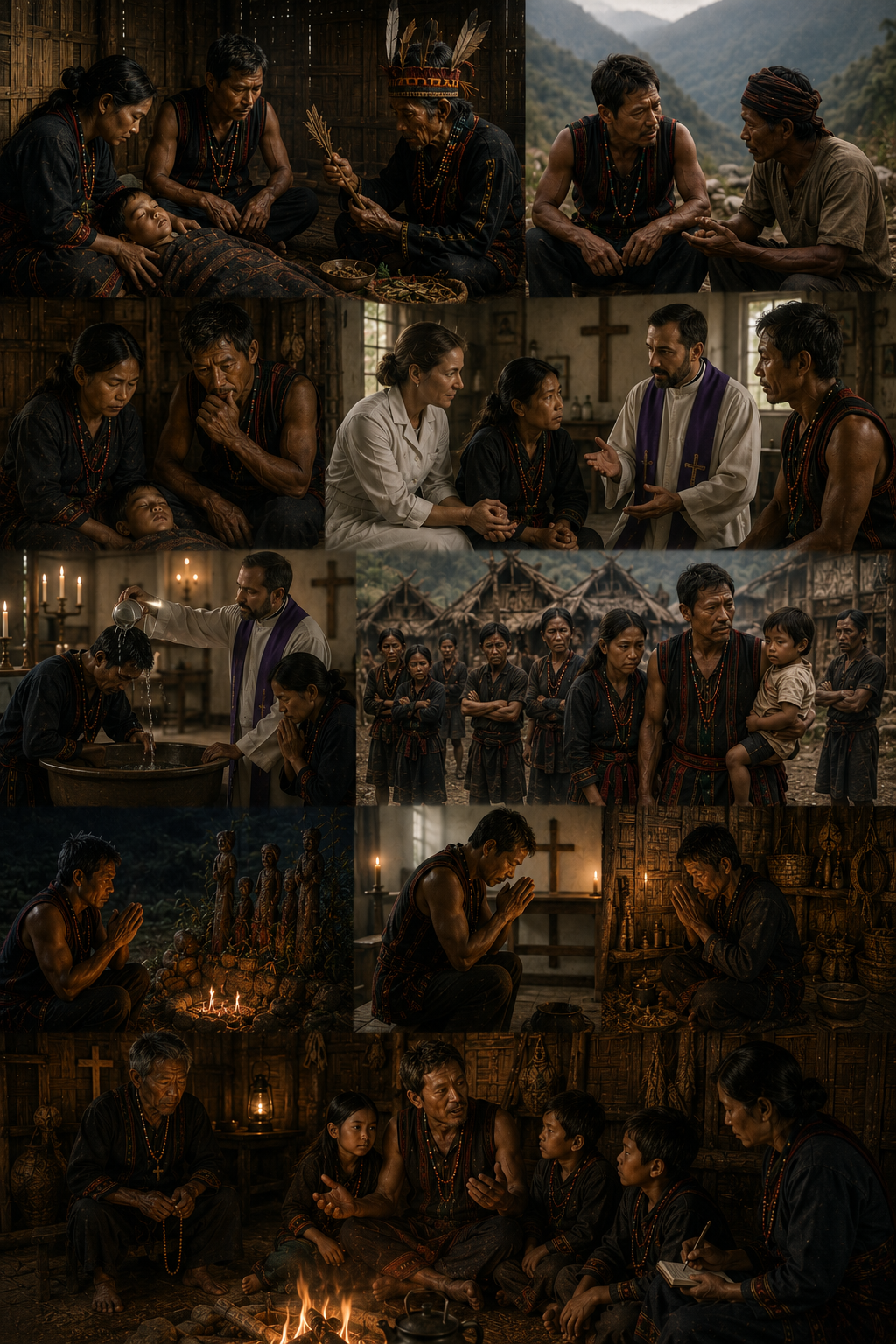
"The nyibu came," Tanga said. "I remember his face, though I was delirious. He was old then. Respected. He performed the rituals, consulted the spirits, demanded offerings. My grandfather paid him everything we had. Rice. Cloth. His good knife. Chickens for the ceremonies. But I kept dying anyway."
Tanga paused, his voice steady but weighted with the history.
"My father worked alongside a man named Soron. Soron was Adivasi, from the tea gardens in Assam. His people had been brought there as laborers, worked almost to death. Years ago, when Soron was dying of the same fever that now claimed me, the Catholics came to the tea gardens. Sister Catherine, a doctor from Bangalore, treated him without asking for payment first. Just like that. Kindness without a transaction."
I found myself leaning forward. This was the hinge moment—where desperation met a choice that was also a mercy.
"Soron told my father about the mission clinic in Pasighat," Kinma continued. "About a doctor there who had real medicine. But he also told him the truth—the missionaries would ask him to convert. They would say that the medicines could only work if he left his sinful way of life, confessed his sins, asked forgiveness in the name of Christ. It wasn't hidden. Soron was honest about the cost."
I thought: What price is reasonable for your child's life? What does a man surrender to save his son?
"My father was terrified," Kinma said quietly. "Not of me dying—he'd already buried four children. He was terrified of what conversion meant. The village would cast us out. The ancestors would turn their faces. The nyibu would curse us. We'd be dead to our own people, even if we lived."
Tadak's eyes opened. He looked at his son across the decades of that decision. His lips continued their movement—prayer to Christ, apology to the ancestors.
"But my father was also exhausted," Tanga said. "He'd spent everything trying to save me the traditional way. The nyibus had taken his money and given nothing back. The spirits hadn't answered. The old gods had already failed him four times over. And then the missionaries came—not to the village, but to the clinic in Pasighat—with medicine and with something else: charity. Real charity. Not payment-for-ritual. Not negotiation. Just help."
Tanga's voice steadied.
"The missionaries didn't deceive my father. They told him clearly: convert or watch your son die. But they also showed him kindness. They treated the sick without asking questions first. Sister Catherine gave medicine to strangers. She told my father something I'll never forget. She said that healing comes not just from medicine in a bottle, but from the healing of the heart. That when you stop running from God, when you truly accept His love—that's when true healing begins."
One of Tanga's sons—the logical child, needing the equation to balance—asked: "So they forced him to convert?"
"No," Tanga said carefully. "They offered him a choice. They said: convert and your son will live. Don't convert and your son will almost certainly die. That's not forcing. That's presenting the only option that made sense. And they were honest about it. They didn't hide what they believed. They didn't pretend it was just medicine—they said it was medicine plus faith, body plus spirit."
He paused.
"My father understood the transaction. He wasn't tricked. He knew that accepting Christ meant renouncing the ancestors. He knew the village would cast him out. But he was also a man who'd already lost four children to the spirits he served. What did he owe them anymore? Sister Catherine looked at him with such compassion, such genuine belief that Christ could heal not just my body but my spirit—how could he refuse?"
Tanga looked at his father in the corner.
"He chose my life over his gods," Tanga said. "And that was a choice no one should have to make. But he made it. He walked to the mission clinic, and he knelt in that chapel, and he renounced everything he'd been taught to believe. He asked forgiveness in the name of Christ. And I lived."
Tadak's eyes closed again.
"What your grandfather didn't know," Tanga continued, "was that you would be half-convert. That you could pray to Christ in the chapel and whisper to the old spirits at night. That you could live in both worlds, never fully belonging to either. Always in a state of liminality. I watched him do it for forty years. Praying to Jesus at dawn. Whispering apologies to the ancestors at dusk. Split in half, but alive."
Tanga looked directly at me then.
"You wonder what if," he said. "What if the missionaries hadn't come. What if Soron hadn't told my father about the clinic. What if we'd chosen the village, the ancestors, the old ways. What if I'd died, and my parents had buried me like the other four."
I hadn't expected him to articulate it so directly.
"I think about that too," Tanga said. "Every day. Because my existence, my life, my children—it all rests on an act of desperation. On my father's willingness to trade his gods for my life. The missionaries didn't force him. But they presented the choice in a way that couldn't be refused by a man watching his son die."
He paused.
"Were they wrong to do that? I don't know. They were kind people. Sister Catherine genuinely loved the patients she treated. She believed with all her heart that Christ could heal people in ways the old spirits couldn't. Father Alvares genuinely believed that he was offering salvation, not selling conversion. They weren't villains. But they were also powerful. They had medicine. They had knowledge. They had resources. And they said: you can have these things, but only if you become like us. Only if you renounce everything that made you who you are."
Tanga's daughter squeezed his arm, and he continued.
"My grandfather paid that price. And I exist because of it. I'm alive, educated, my children are healthy. But I'm also something my father wasn't supposed to become. I'm Christian. I pray in a chapel instead of at the river. I read the Bible instead of listening to the nyibu. And your grandfather—he spent forty years trying to be both things at once, failing at both, succeeding at neither."
He looked at Tadak.
"But he was a good man. He made an impossible choice and lived with it. He accepted Christ genuinely—not just as medicine but as faith. And he also honored the ancestors in his heart, even though the village said he won't. He was broken, yes. Split. But he was alive, and I was alive, and that had to matter."
In the corner, Tadak's lips moved in the language of prayer—whether to Christ or to the spirits or to some hybrid faith only he understood, I couldn't tell. Maybe he was apologizing. Maybe he was asking forgiveness. Maybe he was simply holding both worlds in his heart at once, the way a broken vessel holds water: imperfectly, but still holding.
The fire burned lower. Tanga's children leaned against him, the weight of their existence pressing gently into his side—the proof of his father's choice, living and breathing in the darkness, the first generation born fully Christian because their grandfather had to choose between his gods and his son.
Outside, the night held its secrets. In villages throughout the region, families carried similar stories—the choice between death and conversion, between blood and faith, between the old gods and the new medicine. Each one was particular. Each one was the same.
I closed my notebook and sat in the dark with them, thinking about what it means to survive by becoming something your own people can no longer recognize. Thinking about the price that even mercy extracts. Thinking about desperation and faith, about the missionaries who were neither angels nor demons but simply people offering what they had to those with nothing left to lose—offering it with genuine care and genuine belief.
Tadak prayed on, a man translated into a new language, still aching in the old one. A man who'd chosen his son's breath over his ancestors' approval. A man who'd spent four decades trying to apologize to both.
And his son sat with his children, telling the story that explained everything about who they were and why it had cost so much.

Write a comment ...